Roster building at Champions Shanghai follows two workable philosophies: broad role flexibility and deep specialization. Based on THESPIKE’s review of the last six months, TYLOO’s Slowly sits at the wide end of the spectrum, having played 14 Agents across four roles. Several other competitors lean heavily on one signature pick or a narrowly defined job. The data is descriptive rather than an official Riot ranking, and a smaller pool alone does not signal a weaker player.
The more useful question is not how many Agents are listed beside a name. Flex players can cover multiple roles, which lets a team shift responsibilities without swapping out a teammate. A specialist might use fewer picks, yet offer reliability in a role the composition needs on nearly every map. Concentration adds another dimension: a pool that looks broad on paper can still center on a single Agent if that pick makes up most of the appearances.
Slowly is the clearest case of breadth in the study. His 14 Agents across four roles let TYLOO reshape compositions while the same player keeps moving between responsibilities. LOUD’s Darker also covered four roles, but Omen, Vyse and Viper were his most frequent choices. Put side by side, the two cases show why role coverage and Agent count should be read together: both players can switch jobs, yet their actual distributions show where each team has really used them.
A wide list can still contain a clear identity
Team Liquid’s Kicks shows the gap between availability and frequency. He has played Omen in 28 games, Skye in 11 and Breach in 9. Those Agents span different utility profiles, but Omen stays well ahead of the rest. Labeling him a pure one-trick or a fully role-neutral flex would ignore part of the record. He has options, yet his recent match history still points to a Controller in the center.
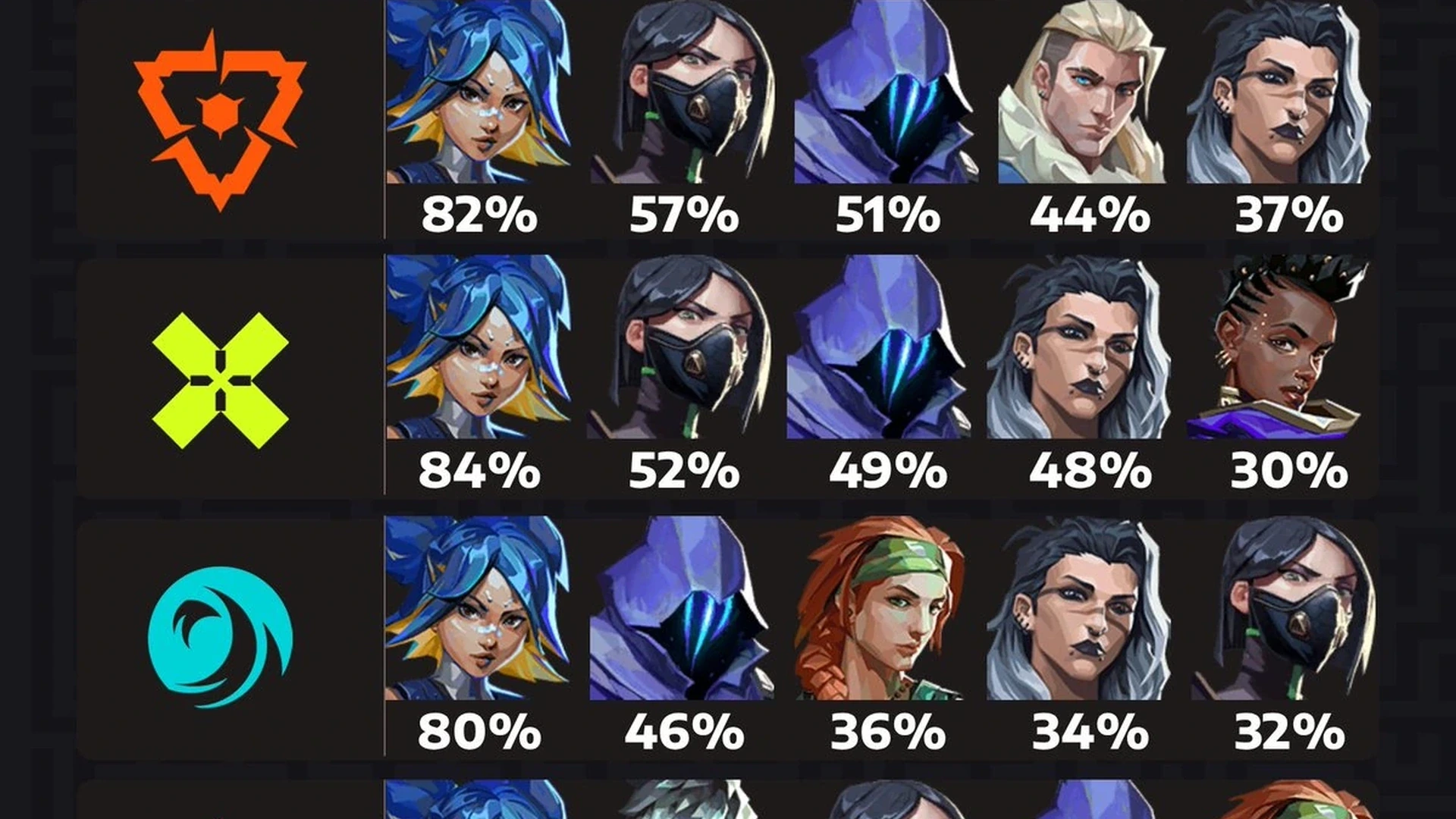
dos9 shows the same caution. He used seven Agents over the period, a figure that looks broad at first glance, but Omen made up 67.2 percent of his games. Concentration reveals a signature pick that the raw count hides. Paper Rex’s f0rsakeN offers the opposite long-term picture: the article notes he has played every Agent over his professional career, while ranking seventh in this particular six-month analysis. A career range and a six-month ranking cover different time windows, so they do not contradict each other.
Specialists differ from one another too. FUT uses s0pp mainly on Neon and Jett, keeping an aggressive entry role. vora played four Agents for 100 Thieves, with Sova appearing on 35 of 62 maps and Fade serving as another information-focused pick. SUYGETSU’s recent group centered on Cypher, Astra, Viper and Vyse, a lineup built around defensive control. Team Liquid captain nAts mostly played Viper and Cypher, with Cypher accounting for more than half of his games, while Killjoy and a single Vyse appearance provided alternatives.
None of these distributions proves a player is incapable of playing something else. They describe what teams actually picked during the measured period. A consistent specialist makes utility timing and role expectations repeatable, whereas a broad flex opens up composition changes without forcing several teammates to relearn positions. What matters depends on the surrounding lineup, the map and the strategic plan, not on a single ideal pool size.
How to read the data at Champions
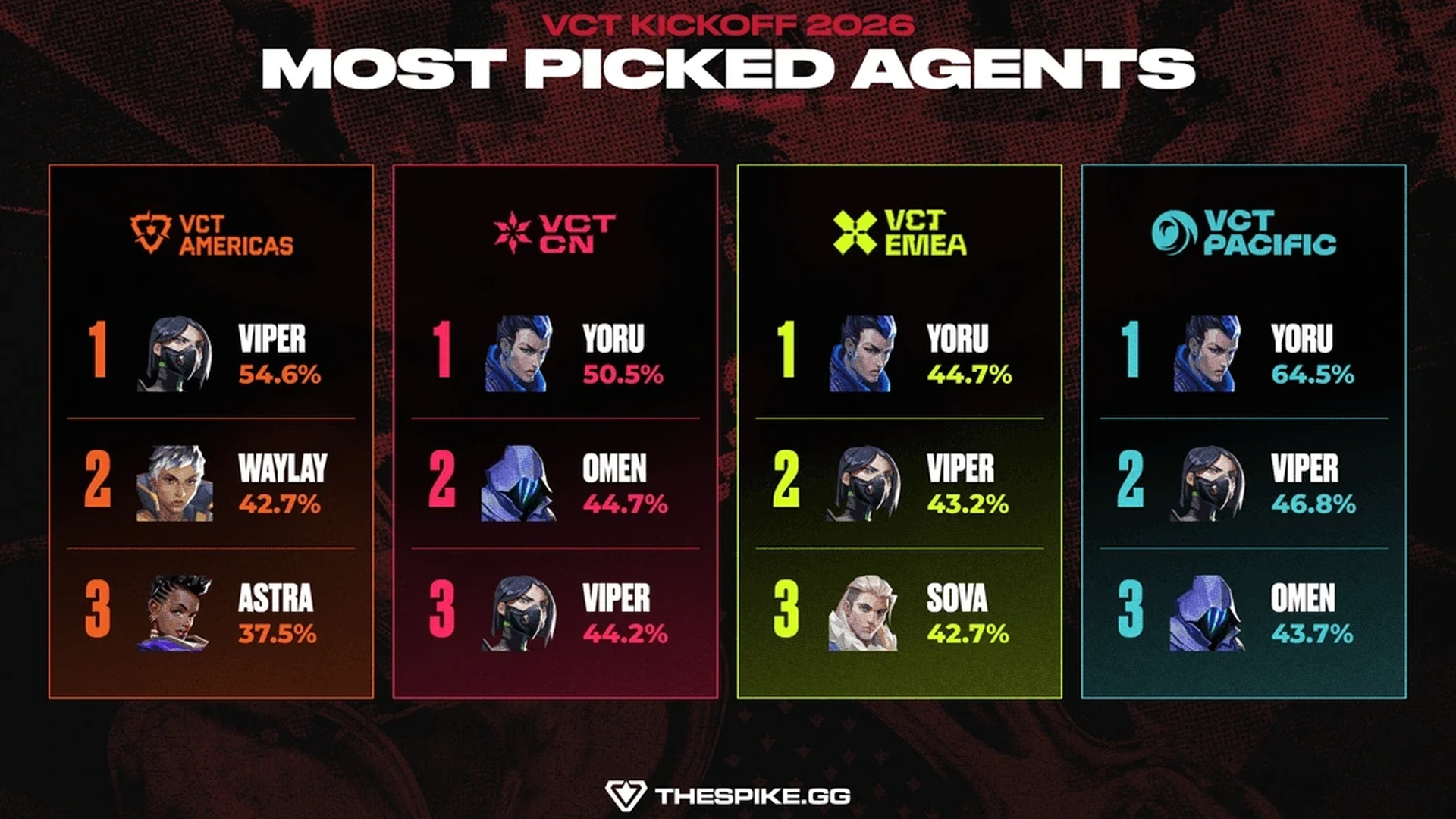
The most responsible use of these figures is as a preparation tool rather than a prediction. Opponents can study the most concentrated picks and plan around familiar utility patterns. Teams with flexible players can answer by shifting responsibilities or showing a less common composition. Specialists can respond differently, by executing a well-practiced role even when the opponent expects it.
Three separate measures matter here. Agent variety counts available selections. Role coverage records how many distinct jobs a player has handled. Concentration shows whether one or two picks dominate actual use. A player can rank high on one measure and modestly on another without the data contradicting itself. Kicks and dos9 illustrate this especially clearly, while Slowly represents breadth across both picks and roles.
Champions Shanghai will test how well each model holds up, but pre-event figures cannot tell us which one will win. Map choices, team compositions and opponent preparation will decide when flexibility pays off and when specialization is the better call. The data captures recent habits; it does not lock any competitor into them for the tournament.
Champions Shanghai’s Agent data rewards a layered reading. Slowly’s broad role coverage and the concentrated pools of players like s0pp, vora and nAts represent different team tools rather than a simple best-to-worst ranking. Agent count only becomes meaningful when role range and actual pick concentration are considered alongside it.